If you have more than one debt, the hardest question isn’t whether to pay them off. It’s which one to pay first. The two most popular answers are the debt snowball and the debt avalanche. Both work. They just work differently, and the best one is the one you’ll stick with.
Here’s how each method works, a side-by-side example with real math, and how to choose.
The short answer
- Debt avalanche: pay the debt with the highest interest rate first. It usually costs the least interest.
- Debt snowball: pay the debt with the smallest balance first. You get your first win faster, which keeps many people motivated.
With both methods you keep paying the minimum on every debt and put all your extra money on one “focus” debt. When it’s paid off, you roll its payment into the next one.
How the debt snowball works
- List your debts from the smallest balance to the largest. Ignore interest rates.
- Pay the minimum on every debt.
- Put every extra dollar on the smallest debt.
- When it’s gone, add its payment to the next smallest debt. Your payment “snowballs” as you go.
Why people like it: you see a debt disappear quickly. That early win can make it easier to keep going for months.
How the debt avalanche works
- List your debts from the highest interest rate to the lowest. Ignore balances.
- Pay the minimum on every debt.
- Put every extra dollar on the debt with the highest rate.
- When it’s gone, move its payment to the next highest rate.
Why people like it: you attack the most expensive debt first, so you usually pay less interest overall and may finish a little sooner.
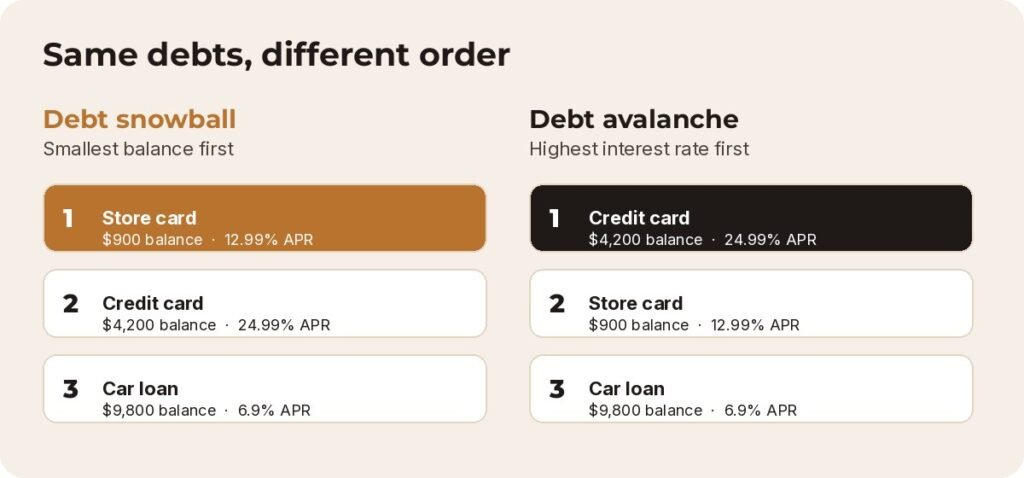
Snowball vs avalanche: a real example
Let’s say you have these three debts and can pay $200 extra each month on top of your minimums:
| Debt | Balance | Interest rate (APR) | Minimum payment |
|---|---|---|---|
| Credit card | $4,200 | 24.99% | $105 |
| Store card | $900 | 12.99% | $35 |
| Car loan | $9,800 | 6.9% | $260 |
Here are the estimates from our free Debt Payoff Calculator (fixed rates, no new charges):
| Snowball | Avalanche | Minimums only | |
|---|---|---|---|
| Payoff order | Store card → Credit card → Car loan | Credit card → Store card → Car loan | — |
| First debt paid off | Month 4 | Month 17 | — |
| Debt-free in | 29 months | 29 months | 50 months |
| Total interest | about $2,072 | about $1,949 | about $4,884 |
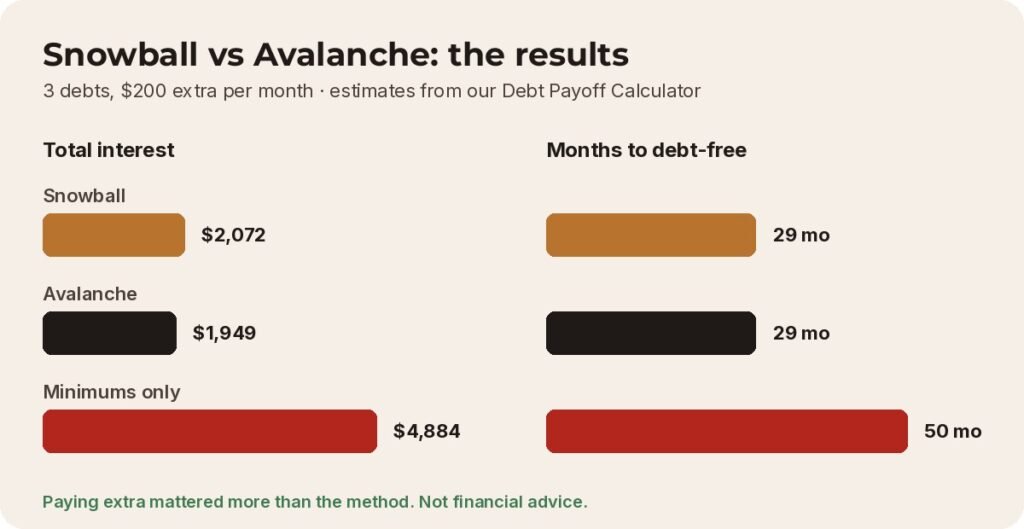
What this shows:
- Avalanche saved about $123 in interest in this example.
- Snowball gave the first win 13 months sooner (month 4 instead of month 17).
- The biggest difference isn’t the method. Paying $200 extra a month, with either method, saved roughly $2,800 to $2,950 in interest and about 21 months compared with paying minimums only.
Your numbers will be different. When rates are far apart and balances are large, the avalanche can save much more. When your smallest debts are also high-rate, both methods can give almost the same result.
Try it with your own debts
Enter your balances, rates and minimum payments to compare Snowball and Avalanche side by side. Free, no signup, nothing is saved.
Watch: snowball vs avalanche explained
Here’s a short video that walks through both methods and how to choose.
Which method fits you?
Ask yourself these questions:
- Have you tried to pay off debt before and given up? The snowball’s quick wins may help you stay motivated.
- Do you have a high-interest debt with a big balance? The avalanche may save you a lot of money.
- Are the results close with your numbers? Pick the one that feels better. Consistency matters more than the method.
You can also use a custom order. For example, start with one small debt for a quick win, then switch to the highest rate.
How to start this week
- List every debt: balance, interest rate, minimum payment and due date. Your statements or online accounts have this information.
- Find your extra amount. Look at your budget and decide how much you can add each month, even $25 helps. Our biweekly budgeting guide can help you find it.
- Pick your method and write down your payoff order.
- Avoid new debt while you pay off the old one, if you can.
- Track your progress every month. Seeing balances go down is what keeps you going.
Track your payoff month by month
The Debt Payoff Tracker for Google Sheets and Excel compares Snowball, Avalanche and Custom side by side, shows your debt-free date, and tells you which debt to focus on this month.
Frequently asked questions
Is the debt snowball or avalanche better?
Mathematically, the avalanche usually costs less interest. In practice, the best method is the one you’ll stick with until the end. Run your own numbers to see how big the difference really is.
Does the debt snowball cost more?
Often a little, because higher-rate debts wait longer. In many cases the difference is small compared with the savings from paying extra every month.
Should I include my mortgage?
Most people use these methods for non-mortgage debts like credit cards, car loans, personal loans and student loans.
Should I save or pay off debt first?
Many people keep a small emergency fund first so a surprise expense doesn’t go back on a credit card. Your situation is unique, so consider talking with a qualified professional for personal advice.
This article is for general education only and isn’t financial advice. Example numbers are made up for illustration.