Getting paid every two weeks sounds simple, until you try to budget it. Your rent is due once a month, your paychecks arrive every 14 days, and some months the money seems to run out before the next payday. The good news: once you set it up the right way, a biweekly paycheck is actually easier to budget than a monthly one, and it even gives you two “bonus” paychecks a year.
In this guide you’ll learn how to budget a biweekly paycheck in five simple steps, with an example you can copy.
Why biweekly pay makes budgeting feel harder
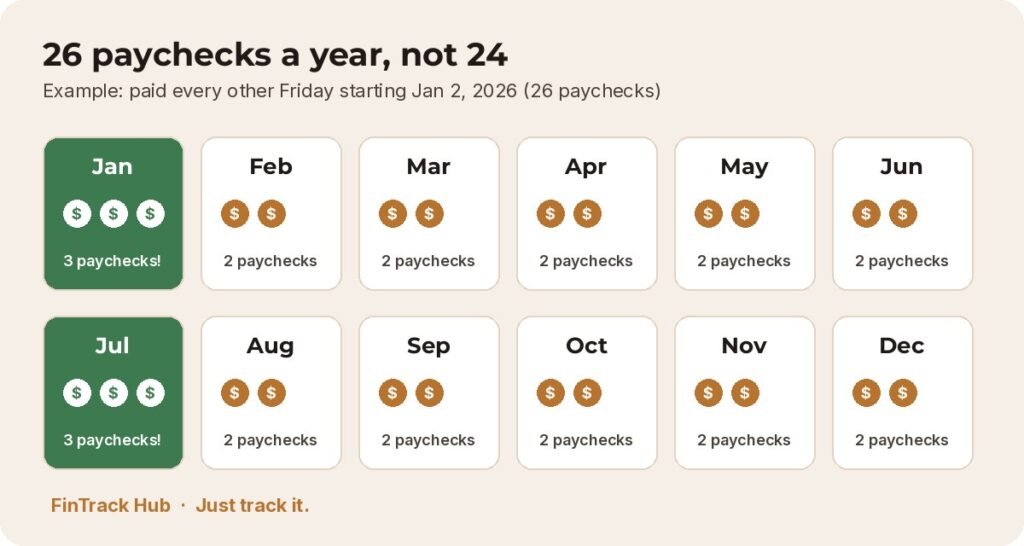
A year has 52 weeks, so biweekly pay gives you 26 paychecks a year, not 24. That means most months you get two paychecks, but two months a year you get three.
The problem is that most bills are monthly. If you divide your yearly pay by 12 and plan a “monthly budget,” your plan won’t match what actually lands in your bank account each month. Some months feel tight, some months feel rich, and it’s hard to tell why.
The fix is to stop budgeting by the month and start budgeting by the paycheck.
Step 1: Know your real take-home pay
Start with your net pay: the amount that actually hits your bank account after taxes, insurance and retirement contributions. Don’t use your salary. Look at your last two pay stubs or your bank deposits.
In our example, take-home pay is $2,000 per paycheck. That’s about $4,333 a month on average, but in a normal two-paycheck month you only receive $4,000. Budget on the $4,000.
Step 2: List your bills with their due dates
Write down every regular bill and the day of the month it’s due: rent, utilities, phone, internet, insurance, car payment, minimum debt payments, subscriptions. Then add your everyday spending categories, like groceries and gas.
Don’t forget bills that come every few months or once a year (car insurance, renewals). Divide them by 12 and set that amount aside every month so they never surprise you.
Step 3: Match each bill to the paycheck that pays it
This is the key step. Give each bill to a paycheck:
- Paycheck A (the first paycheck of the month) pays the bills due roughly between the 1st and the 14th.
- Paycheck B (the second paycheck) pays the bills due from the 15th to the end of the month.
If one paycheck ends up with too many big bills, call the company and ask to move a due date. Many lenders and utility companies allow it.
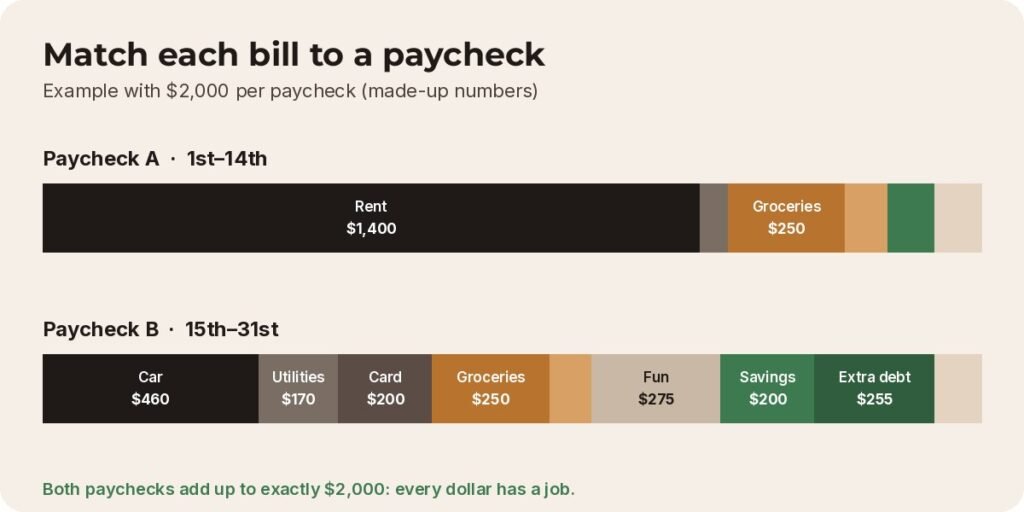
Here’s what that looks like with $2,000 paychecks:
| Paycheck A: $2,000 | Amount |
|---|---|
| Rent | $1,400 |
| Phone | $60 |
| Groceries (2 weeks) | $250 |
| Gas | $90 |
| Savings | $100 |
| Buffer | $100 |
| Total | $2,000 |
| Paycheck B: $2,000 | Amount |
|---|---|
| Car payment | $320 |
| Car insurance | $140 |
| Electricity | $110 |
| Internet | $60 |
| Credit card payment | $200 |
| Groceries (2 weeks) | $250 |
| Gas | $90 |
| Streaming | $25 |
| Dining out & fun | $250 |
| Savings | $200 |
| Extra debt payment | $255 |
| Buffer | $100 |
| Total | $2,000 |
Step 4: Give every dollar a job
Notice that both paychecks add up to exactly $2,000. Every dollar has a job before the paycheck arrives: bills, spending, savings or debt. This is called a zero-based budget, and it’s the easiest way to stop wondering where your money went.
A small buffer in each paycheck (we used $100) covers the little surprises, so one unexpected expense doesn’t break your plan.
Want to skip the math? Our free Paycheck Budget Calculator shows how much of each paycheck to set aside for bills, savings and debt.
Step 5: Plan your two “extra” paychecks
Because you budgeted on two paychecks a month, the two months with a third paycheck give you a full extra paycheck to use. Decide in advance what it’s for, so it doesn’t disappear into everyday spending. Common choices:
- Building or topping up your emergency fund
- Extra payments on your debt
- Yearly bills like car insurance, renewals or holiday gifts
- A savings goal, like a trip or a new laptop
Tip: look at a calendar now and mark the two months that have three paydays this year.
Check in every payday (10 minutes)
A budget only works if you look at it. Every payday, take 10 minutes to:
- Check that last paycheck’s bills were paid.
- Write down what you actually spent in each category.
- Adjust the next paycheck’s plan if something changed.
That’s it. After two or three paydays, it becomes a habit.
Plan every paycheck in one place
Our budget planners for Google Sheets, Excel and Notion let you plan by the way you actually get paid (weekly, biweekly or monthly) and add up everything for you.
Watch: how a budget comes together
Prefer video? This short lesson from Khan Academy walks through a simple budget example.
Frequently asked questions
Should I budget monthly or per paycheck?
If you’re paid biweekly or weekly, budgeting per paycheck usually works better, because it matches when money actually arrives. Monthly budgets work best for people paid once a month.
What if my paycheck amount changes?
Budget on your lowest typical paycheck. When a paycheck is bigger, give the difference a job right away, for example savings or extra debt payments.
What if all my big bills fall on the same paycheck?
Ask your landlord or lenders if you can change a due date. If that’s not possible, set aside part of the earlier paycheck so the money is ready when the bill is due.
Where do I start if I’ve never budgeted before?
Start by tracking one month of spending so you know your real numbers. Our Start Here quiz can help you find your first step.
This article is for general education only and isn’t financial advice. Example numbers are made up for illustration.