Money is one of the most common things couples argue about, and splitting bills is often where it starts. When you earn about the same, 50/50 feels fair. But when one partner earns a lot more, an even split can leave one person stretched thin while the other has plenty left over.
Here are the three most common ways to split shared bills, how to calculate a fair split by income, and how to talk about it without a fight.
Why 50/50 doesn’t always feel fair
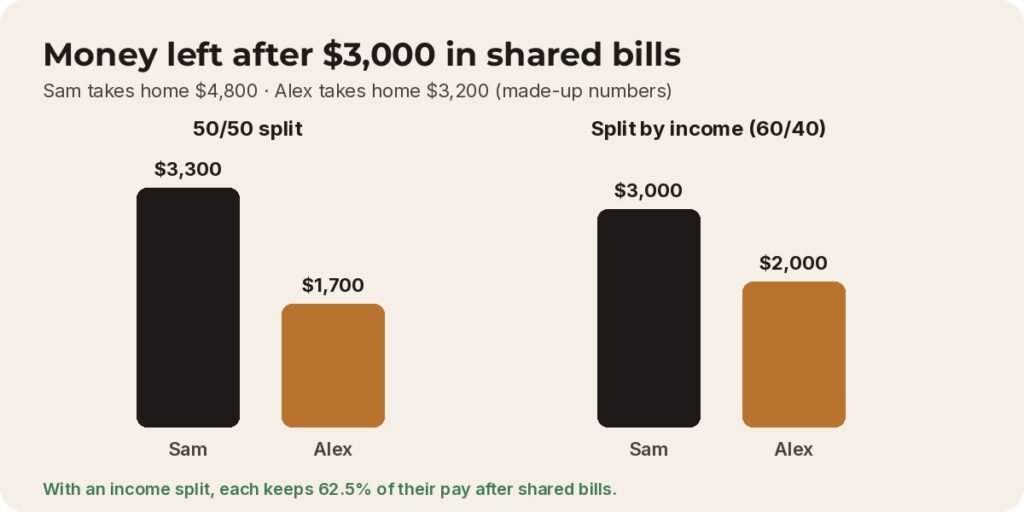
Imagine Sam takes home $4,800 a month and Alex takes home $3,200. Their shared bills (rent, utilities, groceries) add up to $3,000.
With a 50/50 split, each pays $1,500. Sam has $3,300 left. Alex has only $1,700 left, almost half as much, for all personal spending, savings and debt.
Nobody is doing anything wrong. The split just doesn’t match their incomes. That’s why many couples choose a different method.
3 common ways couples split bills
1. The 50/50 split
Each partner pays half of every shared bill.
- Works well when: you earn about the same.
- Watch out: it can feel unfair when incomes are very different.
2. Split by income (proportional)
Each partner pays the same percentage of their income, so the higher earner pays more in dollars.
- Works well when: incomes are different and you want to keep some money separate.
- Watch out: you’ll need to update the percentages when an income changes.
3. Fully combined money
All income goes into one shared pot, and all bills are paid from it. Many couples still give each partner a set amount of personal “fun money.”
- Works well when: you’re married or fully share your financial goals.
- Watch out: it needs a lot of trust and regular money talks.
How to split bills by income (step by step)
- Add up both take-home incomes. $4,800 + $3,200 = $8,000.
- Find each partner’s percentage. Sam: $4,800 ÷ $8,000 = 60%. Alex: $3,200 ÷ $8,000 = 40%.
- Apply it to your shared bills. Sam pays 60% of $3,000 = $1,800. Alex pays 40% = $1,200.
| Sam | Alex | |
|---|---|---|
| Take-home pay | $4,800 | $3,200 |
| Share of income | 60% | 40% |
| Pays toward $3,000 shared bills | $1,800 | $1,200 |
| Left after shared bills | $3,000 | $2,000 |
Now each partner keeps the same share of their own income (62.5%) after shared bills. That’s what makes it feel fair.
What counts as a shared expense?
Agree on this first, because it’s where most disagreements start. Common shared expenses:
- Rent or mortgage
- Utilities, internet and streaming you both use
- Groceries and household supplies
- Shared insurance, kids’ costs and pet costs
- Date nights and trips you take together (if you agree)
Personal spending, like your own clothes, hobbies or individual debt, usually stays personal.
Settle up once a month
In real life, one person pays the rent and the other buys most of the groceries. Instead of splitting every receipt, track who paid what and settle up once a month.
Example: this month Sam paid $2,100 in shared bills and Alex paid $900. Sam’s fair share was $1,800, so Sam paid $300 too much. Alex sends Sam $300, and you’re even.
How to talk about money without a fight
- Pick a calm moment. Not right after a big purchase or an argument.
- Look at the same numbers together. A shared spreadsheet keeps things clear and honest.
- Talk about goals, not just bills. A home, a trip, being debt-free: shared goals make the plan feel like teamwork.
- Check in monthly. Ten minutes at month-end to settle up and adjust.
- Be ready to change the method when life changes: a new job, a move, a baby.
Let a template do the math
The 2027 Couples Budget Planner for Google Sheets and Excel splits bills fairly by income, tracks shared spending, and shows who owes whom at the end of the month.
Watch: build your shared budget
Once you’ve agreed on a split, you still need a plan for the rest of your money. This short Khan Academy video explains the popular 50/30/20 rule as a starting point.
Frequently asked questions
Is it fair to split bills based on income?
Many couples find it fairer when incomes are very different, because each person pays the same share of what they earn. The “right” method is the one you both agree feels fair.
Should couples have a joint bank account?
Some do, some don’t, and many use both: a joint account for shared bills and separate accounts for personal spending. Choose what fits your relationship.
What if one partner has debt?
Most couples keep debt from before the relationship as a personal expense, but some choose to tackle it together. Our debt snowball vs avalanche guide can help you plan the payoff either way.
How often should we settle up?
Once a month works well for most couples. It’s often enough to stay fair and rare enough not to feel like a chore.
This article is for general education only and isn’t financial advice. Example numbers are made up for illustration.